French UN peacekeeper killed in Lebanon, France and Poland agree to build joint military satellite and French and German mediators work to save fighter jet project
This week, the Bern Security Dialogue launched its first symposium in Bern, a proto-type of what serious discourse in this very provincial Swiss capital can be. Over two days, we addressed issues like civil society, Europe's frontlines, threats to the liberal geoeconomic order and multi-domain threats confronting Europe with thought provoking panel discussions. The speakers included, in no particular order, a retired German general and a retired Danish colonel, a Georgetown University professor and Washington think tanker, a Russian dissident journalist, an American investigative reporter and technologist, Swiss voices with deep experience in corporate America in the defense, energy and finance sectors and an American filmmaker, curator and architect.
The conversations that came out of this encounter over the past two days were insightful, enlightening and thought provoking. It is my hope that all who attended, including ambassadors, military officers, civil servants, academics and business elites, walked away enriched by the experience having learned something new and potentially even unexpected. If you were there and care to answer what you learned from our discussions, please drop me a note, we would love to hear from you: amanda.rivkin@securitydialogue.org.
On a personal note, it was perhaps the best two days I have experienced in my time in Bern. In part, it was a chance to reconnect with old colleagues and collaborators, find new allies and expand a growing transatlantic network that answers the same call of duty to our societies many of us feel. Rather than own a sense of complicity as events in the world spiral out of control and become ever more dangerous, we each have decided to take a chance, engage and act, owning our part to shape an uncertain future and demanding that we not be bystanders or victims of circumstances.
As an American at this extended precarious moment, I apologize on the one hand for what is frankly the embarrassing and sad state of affairs in my country. On the other hand, I feel strongly that if the government will not step up, then the citizens must. "We the people" is not just a phrase on paper but a commitment to live up to the promises of our democracies daily. My apologies if that sounds mawkish or overly sentimental but it is the truth.
For me, one highlight was when someone in the defense industry approached at the end during the toast to say the conversation we opened with between the founder of Art Works Projects Leslie Thomas, a long time friend and collaborator, and me was one he was still processing. He did not say why but I suspect it was very far outside the America he sees when traveling to corporate in Texas. To say that this is what we strived for would be an understatement. Personally, I learned a lot about the challenges confronting the global energy economy as it has evolved to the place it finds itself today from another phenomenal woman, Cornelia Meyer.
Another thought provoking reflection came from our partner in this symposium, Manuel Nappo of the NZZ Academy, who asked on LinkedIn about the symposium's title, "The Cost of Freedom". Nappo wrote, "The word cost irritated me," because "Previous generations paid it without hesitation." I would argue they paid it because they had to, because no one asked what the cost of maintaining it was in advance, which is precisely why we must ask and reflect now, what will we pay if we do not maintain our freedoms now—what will be the cost then? If price is a function of supply, then cost is a function of demand. We must demand our rights before they are taken—the price will be much higher later if we do not.
What also made these few days so refreshing is that normally, in my experience in Switzerland, the focus of what passes for security policy discussions in the public space suffers from two fundamental problems, both of which stem from a fundamental lack of seriousness. The first is that the discourse is clouded by a giant elephant in the room called "neutrality" which offers more restrictions than options. From this "neutrality" discourse stems an unnecessary avalanche of feelings, often narcissistic, naval gazing and irrelevant. Dear Swiss, I promise your feelings about your neutrality are fundamentally irrelevant to the security of Europe. To say no one cares would be a fair if blunt assessment. The second problem in Switzerland is that when the discourse is void of seriousness, the apéro afterwards becomes the entire point of the engagement. How many times have I sat through nonsense discussions only to watch people perk up when they have a glass in hand afterwards?
So we did something differently and deliberate. We did not offer a toast until the end. We wanted the dialogue to be the point, not the drinking. When the dialogue was the point, the apéro was not the purpose. Only when we achieve something together should we pause and raise a glass to reflect. I think this week, we can say, yes we achieved something.
Santé!
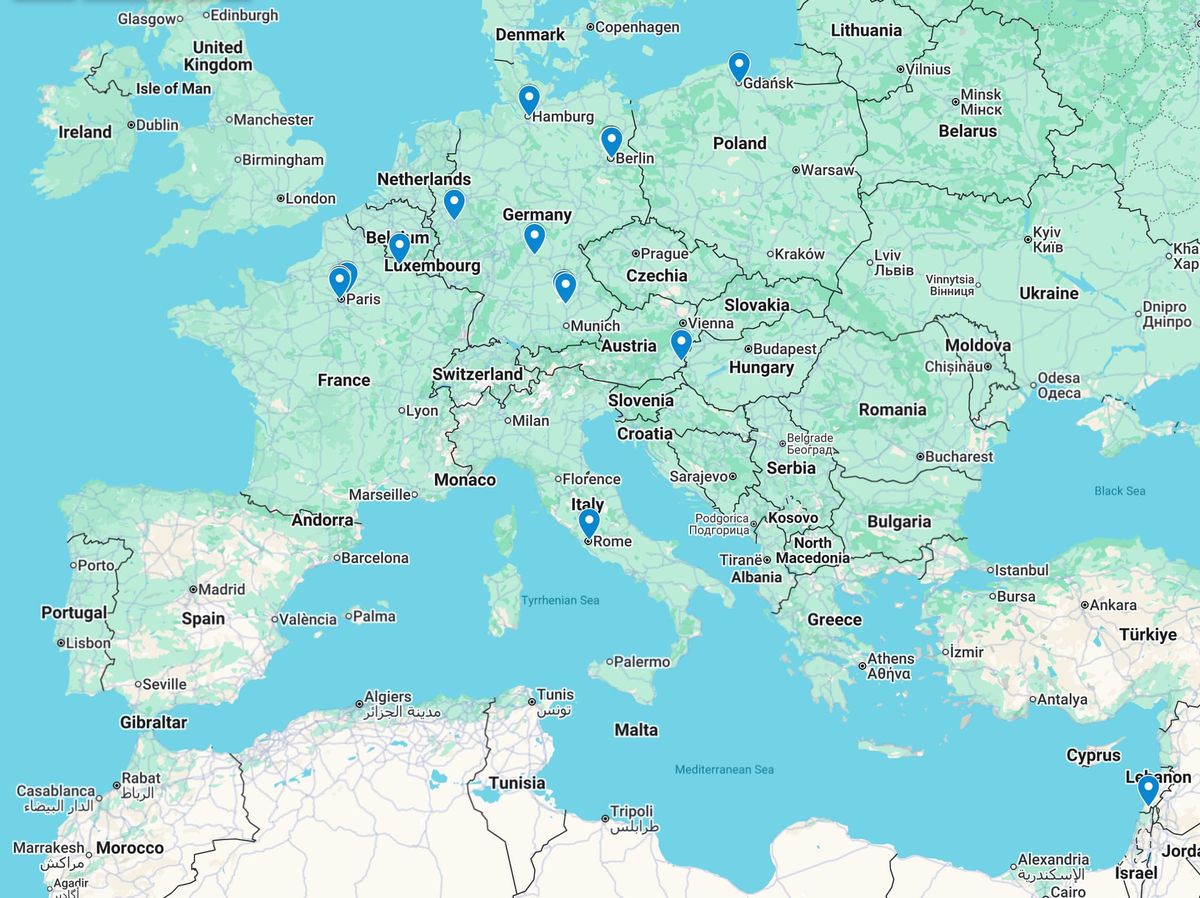
Welcome to the new Alpine Security Monitor! You can subscribe (and become a paid subscriber!) for weekly updates on security and geopolitics as it concerns the Alpine region, namely Austria, Czechia, France, Germany, Italy, Slovenia and Switzerland (ok, little Liechtenstein and Monaco too when merited). If this was forwarded to you, welcome! Questions, complaints, musings, lucrative offers, misguided rants and related ephemera can all be addressed to the management, amanda.rivkin@securitydialogue.org. Now let's get to the week's news from around the Alpine region.
GHANDOURIYEH-BINT JBEIL, LEBANON – French UN peacekeeper killed, three injured
- France 24 reports Saturday that one "French solider was killed," Florian Montorio, 40, "and three others wounded in an ambush Saturday on UN peacekeepers in Lebanon that French President Emmanuel Macron blamed on Hezbollah," which the militant group denies.
- The attack occurs after the state of Lebanon and Israel reached a 10-day ceasefire on Thursday "to negotiate an end to six weeks of fighting between Israel and the Iran-backed group." The UN Secretary General Antonio Guterres said the UN's "initial assessment by the United Nations Interim Force in Lebanon (UNIFIL) found it was carried out by the Iran-backed group." Hezbollah disapproved of the talks with Israel but "denied involvement in the attack."
- Montorio is the second French soldier killed in action since the US and Israel war against Iran began in late February. Arnaud Frion was killed in Iraqi Kurdistan last month.
GDANSK, POLAND – France and Poland announce deal to jointly build military satellite
- Reuters reports Monday that French President Emmanuel Macron and Polish Prime Minister Donald Tusk announced a deal in the northern Polish city of Gdansk to "build a telecommunications satellite for the Polish military" jointly.
- France's Thales Alenia Space and Airbus Defence and Space and Polish firm RADMOR "will jointly develop a satellite in geostationary orbit". The overall "value of the deal" was not announced though "The initiative is part of the European Commission's flagship Readiness defence plan to get the continent ready to defend itself by 2030".
- France and Poland have the highest defense spending by GDP among NATO countries and signed "a cooperation treaty with a mutual assistance clause and a pledge to deepen military and technological links".
SAINT-CLOUD, FRANCE & MANCHING, GERMANY – Mediators try to save joint fighter jet
- The Financial Times reports Wedneday that "France and Germany have given mediators 10 more days to break an impasse over the development of a next-generation fighter jet" in an effort "to save a landmark project of European defence cooperation."
- Dassault Aviation of France and Germany-based Airbus Defence "have been locked in a battle for months" despite efforts by the political leadership of both countries "to rescue the project."
- The dispute over the Future Combat Air System (FCAS) are "largely related to intellectual property and how to split up the work to manufacture the fighter jet."
BERLIN, GERMANY – The Bundeswehr announces 'first ever' military strategy
- Deutsche Welle reports Thursday that for the first time in its 70-year history, "the Bundeswehr has adopted a military strategy to prepare Germany for future threats" with "Large sections of the document" remaining classified.
- The strategy "defines the future focus" of Germany's armed forces, "citing an increasingly dangerous international situation" and declares Russia to be "the greatest and most immediate threat for the forseeable future" while arguing that "Russia is laying the groundwork for a military attack on NATO member states."
- The document also argues for expanding the armed forces considerably "to have a total of 460,000 soldiers ready by the mid-2030s, 200,000 of whom would be in the reserves."
SCHWEINFURT, GERMANY – Germany begins privatization of Gazprom Germania division
- The Financial Times reports Monday that Germany is taking the first steps to privatizing the German division of Gazprom Berlin seized in the wake of Russia's full-scale invasion of Ukraine in 2022, according to the company's chief executive Egbert Laege.
- Now known as Sefe, short for Securing Energy for Europe and formerly known as Gazprom Germania, will "raise €1.5bn-€2.5bn" or $1.76 billion to $2.94 billion) "through a capital increase", using "the funds to expand the side of the business that runs infrastructure assets" including "gas storage and pipelines as well as a UK-based trading business previously known as Gazprom Marketing & Trading."
- The capital increase "will be the first dilution of the German government's 100 percent shareholding". EU Commission rules state it must denationalize "at least 75 percent of its stake by the end of 2028." As the company is "a vehicle for Germany to manage its energy security" certain "investor candidates" could be excluded. Sefe intends to hold onto "its regulated assets and trading options" calling them the "engines" of the company.
COLOGNE, GERMANY – Lufthansa cancels 20,000 flights to save on soaring fuel costs
- The Financial Times reports Thursday that German carrier Lufthansa has cancelled 20,000 flights between May and October to save on soaring jet fuel costs amid the Iran war.
- From Monday, "about 120 daily flights" are to be cancelled and the airline said "it would drop unprofitable routes from Munich and Frankfurt until the end of the summer season".
- "The exact plan" for the busy summer holiday season will be revealed in "late April or early May".
BERLIN, GERMANY – Thousands demonstrate against the government's energy policies
- German press agency dpa reports last Saturday that "Thousands of people took to the streets" to demonstrate against the country's energy policies, including in the capital Berlin.
- Luisa Neubauer, Germany's answer to Greta Thunberg, addressed the crowd in Berlin as protesters gathered under the slogan "Defend renewable energy".
- Energy Minister Katherina Reiche was a target of protesters' ire who they accused "of jeopardizing the success of transitioning to renewable energy and favouring fossil fuels."
HAMBURG, GERMANY – Newspaper makes Nazi relatives searchable online
- CNN reports last Friday that German newspaper Die Zeit has made a new online database searchable for "Nazi party records in order to find out whether their ancestors were card-carrying members" that "has been accessed millions of times since it was launched earlier this month."
- Die Zeit said it launched the portal in an effort to "end the silence born of misplaced shame". The site is run "in conjunction with archives in Germany and the United States." The US Holocaust Memorial Museum notes that by the late 1930s, the "vast majority of Germans supported Hitler and the Nazi state". Die Zeit notes "10.2 million Germans joined the party in the 20 years from 1925 and at its height at the end of World War II it had about 9 million members."
- While "the Nazis sought to destroy the party's vast collection of membership cards" in the waning days of the Second World War, "they were saved at the last minute and handed to the Americans." Copies were later transferred to the German National Archives with copies also kept at the US National Archives.
BERLIN, GERMANY – Crown prince of Iran Reza Pahlavi splattered with red liquid
- The AP reports Thursday that "Iran's exiled Crown Prince Reza Pahlavi was splattered with red liquid on Thursday as he left a building in Berlin."
- Pahlavi was departing a news conference "during which he criticized the ceasefire between the United States and Iran" when he was sprayed with a liquid "coating the back of his blazer and neck". Police said the liquid was likely tomato juice and the perpetrator, whose name has not been released due to German privacy laws, "was immediately detained by police."
- Pahlavi "was not invited to meet with any government representatives during his visit to Berlin".
PARIS, FRANCE -- €6 billion in spending frozen in annual budget this year due to Iran war
- Politico reports Tuesday that "Paris is putting €6 billion" or $7 billion "on hold this year because of the economic fallout of the war in the Middle East."
- Budget Minister David Amiel said the country could not turn "a blind eye to the war nor the debt".
- The government did not say "which ministries will be the most affected, nor when the final decision will be taken".
CHARLEVILLE-MÉZIÈRES, FRANCE – System managing citizens' IDs breached
- Tech Crunch reports Wednesday that the National Agency for Secure Documents (Agence Nationale des Titres Sécurisés or ANTS), which manages citizens IDs, confirmed that it had "experienced a data breach."
- ANTS said evidence indicated that "the data stolen in the breach could include full names, dates and places of birth, mailing and email addresses, and phone numbers on an undisclosed number of citizens."
- The incident is under investigation "to determine how the breach happened and its impact is ongoing". The attack was detected on April 15 and it is likely "millions" are affected.
PARIS, FRANCE – Far-right leader lunches with employer federation executive committee
- France24 reports Tuesday that "France's far-right National rally (Rassemblement national, or RN) president Jordan Bardella sat down for lunch with the executive committee of Medef, the country's largest employer federation."
- The meeting was not a secret but it did take place "under a total media blackout". Not even the menu was known.
- Earlier this month, far-right leader Marine Le Pen "dined at Paris's prestigious Drouant brasserie with some titans of French industry", including business leaders from Engie, TotalEnergies, the Accor hotel group, Renault, Axa insurance and LVMH. The latest meeting is a further sign of both the normalization of the RN as well as the business community's desire to hedge against the possible outcome of a far-right victory in the French presidential elections next year.
COLOMBES, FRANCE – Thousands evacuated as World War II era bomb is detonated
- The BBC reports Sunday that "Thousands of people were evacuated from a northern suburb of Paris," Colombes, "while authorities carried out a bomb disposal operation."
- Residents "living with a 450m radius of where the device was found last month" were asked to leave their homes by 7:00am while residents within a kilometer (.62 miles) were asked to remain indoors until the evacuation order was lifted at 4:00pm. An initial attempt to neutralize the device was unsuccessful which led the authorities to carry out "a controlled explosion" in situ.
- Even 86 years after the start of World War II, "Undetonated WW2 bombs are still found regularly across Europe".
PARIS, FRANCE – 85-year-old widow of army vet returns after 16 days in ICE custody
- NBC News reports French Foreign Minister Jean-Noël Barrot said last Friday evening that the 85-year-old widow of a US Army vet, Marie-Thérèse Ross-Mahé who overstayed her 90-day visa in Alabama and was detained by US Immigration and Customs Enforcement (ICE) for 16 days had returned to France that morning.
- Barrot did not comment on the case while visiting Montpellier other than to say that some of the methods used by ICE are "not in line" with French standards. The New York Times adds she was arrested "amid an inheritance dispute" and notes Barrot said "there were acts of violence" in her case. She landed "still dressed in her prison wear", according to one of her sons who met her at Paris Charles de Gaulle Airport.
- Ross was held in an ICE facility in the US state of Louisiana. She married Alabama resident William Ross in April of last year after the two reconnected. In the 1950s, the two met while working on a NATO base in western France. He was a former captain in the US Army and passed away in January of this year.
VIENNA, AUSTRIA – Austria releases first batch of reserve oil amid Middle East conflict
- Reuters reports that Austria released "the first batch of crude from its reserves under a coordinated plan agreed by International Energy Agency countries" in March "to counter the impact of the Iran war."
- Austria, along with 31 other countries, "agreed to release a record 400 million barrels of oil from strategic stockpiles". It is the sixth such "coordinated stockpile release" since the 1970s, when the by International Energy Agency was created.
- The Austrian release was coordinated with partially state-run oil company OMV. The Austrian share of stockpiles released is roughly 325,000 tons of crude with OMV agreeing to purchase 56,000 tons, Austria's Economy Ministry said in a statement.
BURGENLAND, AUSTRIA – Rat poison found in baby food jar leads to recall
- Reuters reports Sunday that "Rat poison was found inside a jar of Hipp baby food" in Burgenland, Austria, according to police late Saturday, leading to a recall from 1,500 Spar grocery stores. On Monday, Reuters reports the German manufacturer said the contamination was "part of an attempt to extort their manufacturer," adding, "one jar could still be unaccounted for".
- Police in Burgenland said "a sample from one of the 190-gram jars of carrot with potato baby food reported by a customer" which "tested positive for rat poison." On Saturday, Hipp said "it could not be ruled out that a dangerous substance was introduced into the product and that its Hipp Vegetable Carrot with Potato jars may have been tampered with." Police said "the affected jars had a sticker with a red circle on the bottom of the jar and a lid that had already been opened or damaged or missing a safety seal, or had an unusual smell." The company blamed the contamination on "external criminal interference" within "the Spar Austria distribution channel."
- Initial tests on the same brand of baby food in neighboring Czechia and Slovakia also "showed the presence of a toxic substance." The company said it had contacted retailers in both countries to institute a recall on the affected products. Authorities in Austria also said German authorities had "warned about the risk".
ROME, ITALY – Russian ambassador summoned over TV insults against PM Meloni
- Reuters reports Tuesday that the Italian Foreign Minister Antonio Tajani "summoned the Russian ambassador to protest against the insults directed at Prime Minister Giorgia Meloni by a pro-Kremlin Russian television host".
- The one-minute segment by Kremlin mouthpiece Vladimir Solovyev included insults in Italian. Solovyev called Meloni "a certified idiot", "fascist scum" and said, "Betrayal is her middle name".
- Solovyev also attacked Meloni for turning against US President Donald Trump after Trump insulted Pope Leo.
Stay safe and stay engaged!
Did you find this useful? If so, please consider making a one-time contribution, or becoming a subscriber.
If the Alpine Security Monitor was forwarded to you and you wish to subscribe, you can do so here.